Speculative bubbles have been a recurring theme in financial history. One of the first documented market bubbles occurred in the 1600s and involved a booming (or should we say “blooming”?) tulip market in the Netherlands.This mania was documented by Charles Mackay in his book, Memoirs of Extraordinary Popular Delusions and the Madness of Crowds, published in 1841. In addition to its accounts of alchemists, fortune-tellers, and beard taxes, the book recounts stories from the Tulipomania. One such tale follows:
"Another story is told of an English traveller, which is scarcely less ludicrous. This gentleman, an amateur botanist, happened to see a tulip-root lying in the conservatory of a wealthy Dutchman. Being ignorant of its quality, he took out his penknife, and peeled off its coats, with the view of making experiments upon it. When it was by this means reduced to half its size, he cut it into two equal sections, making all the time many learned remarks on the singular appearances of the unknown bulb. Suddenly, the owner pounced upon him, and, with fury in his eyes, asked him if he knew what he had been doing? “Peeling a most extraordinary onion,” replied the philosopher. “Hundert tausend duyvel!” said the Duchman; “it’s an Admiral Van der Eyck.” “Thank you,” replied the traveller, taking out his note-book to make a memorandum of the same; “are these admirals common in your country?” “Death and the devil!” said the Dutchman, seizing the astonished man of science by the collar; “come before the syndic, and you shall see.” In spite of his remonstrances, the traveller was led through the streets followed by a mob of persons. When brought into the presence of the magistrate, he learned, to his consternation, that the root upon which he had been experimentalising was worth four thousand florins; and, notwithstanding all he could urge in extenuation, he was lodged in prison until he found securities for the payment of this sum."
To learn more, read the Tulipomania chapter (along with other chapters on manias and bubbles) in Charles Mackay’s book, Memoirs of Extraordinary Popular Delusions and the Madness of Crowds.
When Law presented himself at court he was most cordially received. He offered two memorials to the regent, in which he set forth the evils that had befallen France, owing to an insufficient currency, at different times depreciated. He asserted that a metallic currency, unaided by a paper money, was wholly inadequate to the wants of a commercial country, and particularly cited the examples of Great Britain and Holland to shew the advantages of paper. He used many sound arguments on the subject of credit, and proposed as a means of restoring that of Prance, then at so low an ebb among the nations, that he should be allowed to set up a bank, which should have the management of the royal revenues, and issue notes both on that and on landed security. He further proposed that this bank should be administered in the king’s name, but subject to the control of commissioners to be named by the States-General.
While these memorials were under consideration, Law translated into French his essay on money and trade, and used every means to extend through the nation his renown as a financier. He soon became talked of. The confidants of the regent spread abroad his praise, and every one expected great things of Monsieur Lass.6
On the 5th of May, 1716, a royal edict was published, by which Law was authorised, in conjunction with his brother, to establish a bank under the name of Law and Company, the notes of which should be received in payment of the taxes. The capital was fixed at six millions of livres, in twelve thousand shares of five hundred livres each, purchasable one fourth in specie, and the remainder in billets d’état. It was not thought expedient to grant him the whole of the privileges prayed for in his memorials until experience should have shewn their safety and advantage.
Law was now on the high road to fortune. The study of thirty years was brought to guide him in the management of his bank. He made all his notes payable at sight, and in the coin current at the time they were issued. This last was a master-stroke of policy, and immediately rendered his notes more valuable than the precious metals. The latter were constantly liable to depreciation by the unwise tampering of the government. A thousand livres of silver might be worth their nominal value one day, and be reduced one-sixth the next, but a note of Law’s bank retained its original value. He publicly declared at the same time, that a banker deserved death if he made issues without having sufficient security to answer all demands. The consequence was, that his notes advanced rapidly in public estimation, and were received at one per cent more than specie. It was not long before the trade of the country felt the benefit. Languishing commerce began to lift up her head; the taxes were paid with greater regularity and less murmuring; and a degree of confidence was established that could not fail, if it continued, to become still more advantageous. In the course of a year, Law’s notes rose to fifteen per cent premium, while the billets d’état, or notes issued by the government as security for the debts contracted by the extravagant Louis XIV., were at a discount of no less than seventy-eight and a half per cent. The comparison was too great in favour of Law not to attract the attention of the whole kingdom, and his credit extended itself day by day. Branches of his bank were almost simultaneously established at Lyons, Rochelle, Tours, Amiens, and Orleans.
The regent appears to have been utterly astonished at his success, and gradually to have conceived the idea that paper, which could so aid a metallic currency, could entirely supersede it. Upon this fundamental error he afterwards acted. In the mean time, Law commenced the famous project which has handed his name down to posterity. He proposed to the regent (who could refuse him nothing) to establish a company that should have the exclusive privilege of trading to the great river Mississippi and the province of Louisiana, on its western bank. The country was supposed to abound in the precious metals; and the company, supported by the profits of their exclusive commerce, were to be the sole farmers of the taxes and sole coiners of money. Letters patent were issued, incorporating the company, in August 1717. The capital was divided into two hundred thousand shares of five hundred livres each, the whole of which might be paid in billets d’état, at their nominal value, although worth no more than a hundred and sixty livres in the market.
It was now that the frenzy of speculating began to seize upon the nation. Law’s bank had effected so much good, that any promises for the future which he thought proper to make were readily believed. The regent every day conferred new privileges upon the fortunate projector. The bank obtained the monopoly of the sale of tobacco, the sole right of refinage of gold and silver, and was finally erected into the Royal Bank of France. Amid the intoxication of success, both Law and the regent forgot the maxim so loudly proclaimed by the former, that a banker deserved death who made issues of paper without the necessary funds to provide for them. As soon as the bank, from a private, became a public institution, the regent caused a fabrication of notes to the amount of one thousand millions of livres. This was the first departure from sound principles, and one for which Law is not justly blameable. While the affairs of the bank were under his control, the issues had never exceeded sixty millions. Whether Law opposed the inordinate increase is not known; but as it took place as soon as the bank was made a royal establishment, it is but fair to lay the blame of the change of system upon the regent.
Law found that he lived under a despotic government; but he was not yet aware of the pernicious influence which such a government could exercise upon so delicate a framework as that of credit. He discovered it afterwards to his cost, but in the meantime suffered himself to be impelled by the regent into courses which his own reason must have disapproved. With a weakness most culpable, he lent his aid in inundating the country with paper money, which, based upon no solid foundation, was sure to fall, sooner or later. The extraordinary present fortune dazzled his eyes, and prevented him from seeing the evil day that would burst over his head, when once, from any cause or other, the alarm was sounded. The parliament were from the first jealous of his influence as a foreigner, and had, besides, their misgivings as to the safety of his projects. As his influence extended, their animosity increased. D’Aguesseau, the chancellor, was unceremoniously dismissed by the regent for his opposition to the vast increase of paper money, and the constant depreciation of the gold and silver coin of the realm. This only served to augment the enmity of the parliament, and when D’Argenson, a man devoted to the interests of the regent, was appointed to the vacant chancellorship, and made at the same time minister of finance, they became more violent than ever. The first measure of the new minister caused a further depreciation of the coin. In order to extinguish the billets d’état, it was ordered that persons bringing to the mint four thousand livres in specie and one thousand livres in billets d’état, should receive back coin to the amount of five thousand livres. D’Argenson plumed himself mightily upon thus creating five thousand new and smaller livres out of the four thousand old and larger ones, being too ignorant of the true principles of trade and credit to be aware of the immense injury he was inflicting upon both.
The parliament saw at once the impolicy and danger of such a system, and made repeated remonstrances to the regent. The latter refused to entertain their petitions, when the parliament, by a bold and very unusual stretch of authority, commanded that no money should be received in payment but that of the old standard. The regent summoned a lit de justice, and annulled the decree. The parliament resisted, and issued another. Again the regent exercised his privilege, and annulled it, till the parliament, stung to fiercer opposition,passed another decree, dated August 12th, 1718, by which they forbade the bank of Law to have any concern, either direct or indirect, in the administration of the revenue; and prohibited all foreigners, under heavy penalties, from interfering, either in their own names, or in that of others, in the management of the finances of the state. The parliament considered Law to be the author of all the evil, and some of the councillors, in the virulence of their enmity, proposed that he should be brought to trial, and, if found guilty, be hung at the gates of the Palais de Justice.
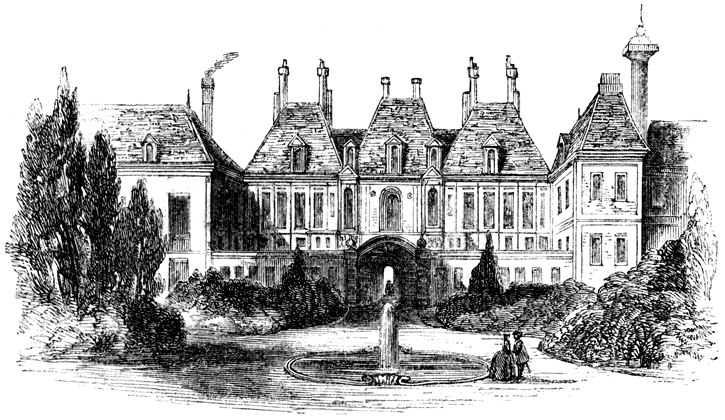
PALAIS ROYAL FROM THE GARDEN.
Law, in great alarm, fled to the Palais Royal, and threw himself on the protection of the regent, praying that measures might be taken to reduce the parliament to obedience. The regent had nothing so much at heart, both on that account and because of the disputes that had arisen relative to the legitimation of the Duke of Maine and the Count of Thoulouse, the sons of the late king. The parliament was ultimately overawed by the arrest of their president and two of the councillors, who were sent to distant prisons.
Thus the first cloud upon Law’s prospects blew over: freed from apprehension of personal danger, he devoted his attention to his famous Mississippi project, the shares of which were rapidly rising, in spite of the parliament. At the commencement of the year 1719, an edict was published, granting to the Mississippi Company the exclusive privilege of trading to the East Indies, China, and the South Seas, and to all the possessions of the French East India Company, established by Colbert. The Company, in consequence of this great increase of their business, assumed, as more appropriate, the title of Company of the Indies, and created fifty thousand new shares. The prospects now held out by Law were most magnificent. He promised a yearly dividend of two hundred livres upon each share of five hundred, which, as the shares were paid for in billets d’état at their nominal value, but worth only 100 livres, was at the rate of about 120 per cent profit.
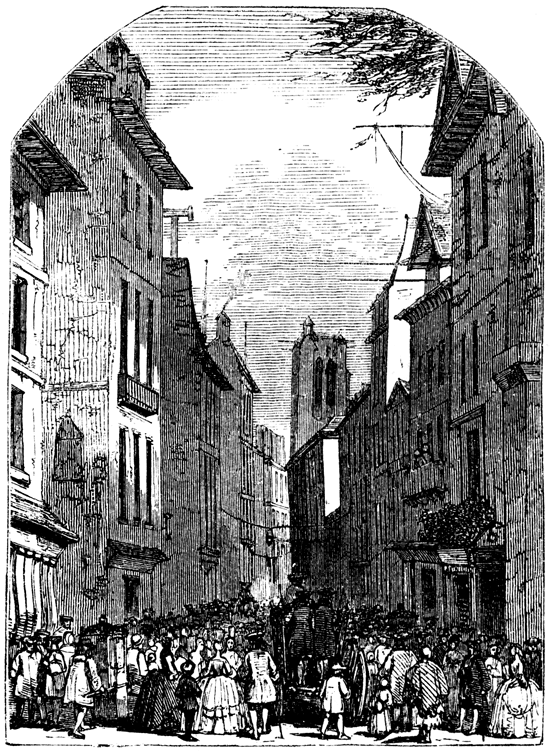
LAW’S HOUSE; RUE DE QUINCAMPOIX.
The public enthusiasm, which had been so long rising, could not resist a vision so splendid. At least three hundred thousand applications were made for the fifty thousand new shares, and Law’s house in the Rue de Quincampoix was beset from morning to night by the eager applicants. As it was impossible to satisfy them all, it was several weeks before a list of the fortunate new stockholders could be made out, during which time the public impatience rose to a pitch of frenzy. Dukes, marquises, counts, with their duchesses, marchionesses, and countesses, waited in the streets for hours every day before Mr. Law’s door to know the result. At last, to avoid the jostling of the plebeian crowd, which, to the number of thousands, filled the whole thoroughfare, they took apartments in the adjoining houses, that they might be continually near the temple whence the new Plutus was diffusing wealth. Every day the value of the old shares increased, and the fresh applications, induced by the golden dreams of the whole nation, became so numerous that it was deemed advisable to create no less than three hundred thousand new shares, at five thousand livres each, in order that the regent might take advantage of the popular enthusiasm to pay off the national debt. For this purpose, the sum of fifteen hundred millions of livres was necessary. Such was the eagerness of the nation, that thrice the sum would have been subscribed if the government had authorised it.
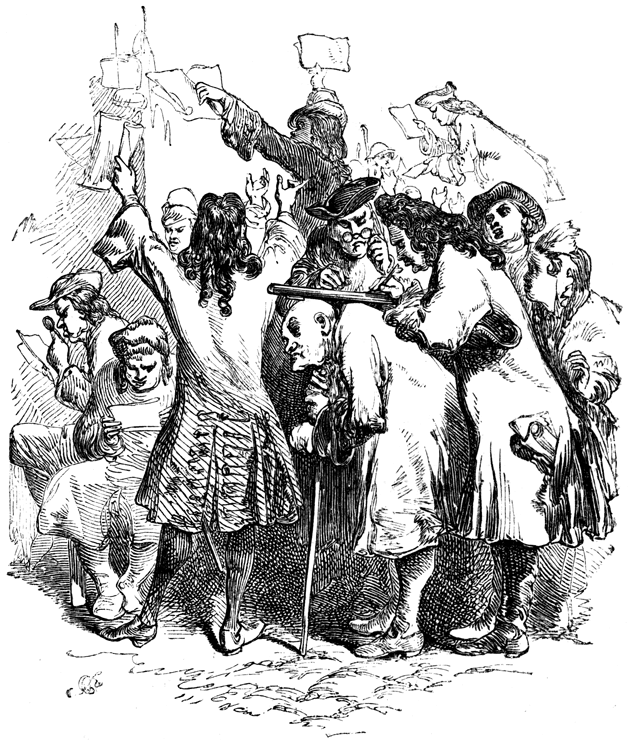
Law was now at the zenith of his prosperity, and the people were rapidly approaching the zenith of their infatuation. The highest and the lowest classes were alike filled with a vision of boundless wealth. There was not a person of note among the aristocracy, with the exception of the Duke of St. Simon and Marshal Villars, who was not engaged in buying or selling stock. People of every age and sex and condition in life speculated in the rise and fall of the Mississippi bonds. The Rue de Quincampoix was the grand resort of the jobbers, and it being a narrow, inconvenient street, accidents continually occurred in it, from the tremendous pressure of the crowd. Houses in it, worth, in ordinary times, a thousand livres of yearly rent, yielded as much as twelve or sixteen thousand. A cobbler, who had a stall in it, gained about two hundred livres a day by letting it out, and furnishing writing materials to brokers and their clients. The story goes, that a hunchbacked man who stood in the street gained considerable sums by lending his hump as a writing-desk to the eager speculators! The great concourse of persons who assembled to do business brought a still greater concourse of spectators. These again drew all the thieves and immoral characters of Paris to the spot, and constant riots and disturbances took place. At nightfall, it was often found necessary to send a troop of soldiers to clear the street.
THE HUNCHBACK.
Law, finding the inconvenience of his residence, removed to the Place Vendôme, whither the crowd of agioteurs followed him. That spacious square soon became as thronged as the Rue de Quincampoix: from morning to night it presented the appearance of a fair. Booths and tents were erected for the transaction of business and the sale of refreshments, and gamblers with their roulette tables stationed themselves in the very middle of the place, and reaped a golden, or rather a paper, harvest from the throng. The boulevards and public gardens were forsaken; parties of pleasure took their walks in preference in the Place Vendôme, which became the fashionable lounge of the idle, as well as the general rendezvous of the busy. The noise was so great all day, that the chancellor, whose court was situated in the square, complained to the regent and the municipality, that he could not hear the advocates. Law, when applied to, expressed his willingness to aid in the removal of the nuisance, and for this purpose entered into a treaty with the Prince de Carignan for the Hôtel de Soissons, which had a garden of several acres in the rear. A bargain was concluded, by which Law became the purchaser of the hotel at an enormous price, the prince reserving to himself the magnificent gardens as a new source of profit. They contained some fine statues and several fountains, and were altogether laid out with much taste. As soon as Law was installed in his new abode, an edict was published, forbidding all persons to buy or sell stock any where but in the gardens of the Hôtel de Soissons. In the midst, among the trees, about five hundred small tents and pavilions were erected, for the convenience of the stock-jobbers. Their various colours, the gay ribands and banners which floated from them, the busy crowds which passed continually in and out—the incessant hum of voices, the noise, the music, and the strange mixture of business and pleasure on the countenances of the throng, all combined to give the place an air of enchantment that quite enraptured the Parisians. The Prince de Carignan made enormous profits while the delusion lasted. Each tent was let at the rate of five hundred livres a month; and, as there were at least five hundred of them, his monthly revenue from this source alone must have amounted to 250,000 livres, or upwards of 10,000l. sterling.
HOTEL DE SOISSONS.
The honest old soldier, Marshal Villars, was so vexed to see the folly which had smitten his countrymen, that he never could speak with temper on the subject. Passing one day through the Place Vendôme in his carriage, the choleric gentleman was so annoyed at the infatuation of the people, that he abruptly ordered his coachman to stop, and, putting his head out of the carriage window, harangued them for full half an hour on their “disgusting avarice.” This was not a very wise proceeding on his part. Hisses and shouts of laughter resounded from every side, and jokes without number were aimed at him. There being at last strong symptoms that something more tangible was flying through the air in the direction of his head, the marshal was glad to drive on. He never again repeated the experiment.
Two sober, quiet, and philosophic men of letters, M. de la Motte and the Abbé Terrason, congratulated each other, that they, at least, were free from this strange infatuation. A few days afterwards, as the worthy abbé was coming out of the Hôtel de Soissons, whither he had gone to buy shares in the Mississippi, whom should he see but his friend La Motte entering for the same purpose. “Ha!” said the abbé smiling, “is that you?” “Yes,” said La Motte, pushing past him as fast as he was able; “and can that be you?” The next time the two scholars met, they talked of philosophy, of science, and of religion, but neither had courage for a long time to breathe one syllable about the Mississippi. At last, when it was mentioned, they agreed that a man ought never to swear against his doing any one thing, and that there was no sort of extravagance of which even a wise man was not capable.
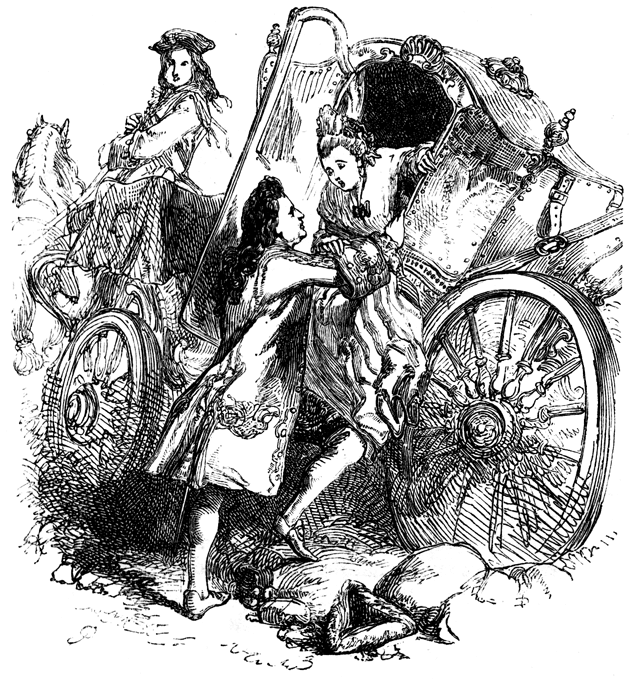
During this time, Law, the new Plutus, had become all at once the most important personage of the state. The ante-chambers of the regent were forsaken by the courtiers, Peers, judges, and bishops thronged to the Hôtel de Soissons; officers of the army and navy, ladies of title and fashion, and every one to whom hereditary rank or public employ gave a claim to precedence, were to be found waiting in his ante-chambers to beg for a portion of his India stock. Law was so pestered that he was unable to see one-tenth part of the applicants, and every manœuvre that ingenuity could suggest was employed to gain access to him. Peers, whose dignity would have been outraged if the regent had made them wait half an hour for an interview, were content to wait six hours for the chance of seeing Monsieur Law. Enormous fees were paid to his servants, if they would merely announce their names. Ladies of rank employed the blandishments of their smiles for the same object; but many of them came day after day for a fortnight before they could obtain an audience. When Law accepted an invitation, he was sometimes so surrounded by ladies, all asking to have their names put down in his lists as shareholders in the new stock, that, in spite of his well-known and habitual gallantry, he was obliged to tear himself away par force. The most ludicrous stratagems were employed to have an opportunity of speaking to him. One lady, who had striven in vain during several days, gave up in despair all attempts to see him at his own house, but ordered her coachman to keep a strict watch whenever she was out in her carriage, and if he saw Mr. Law coming, to drive against a post and upset her. The coachman promised obedience, and for three days the lady was driven incessantly through the town, praying inwardly for the opportunity to be overturned. At last she espied Mr. Law, and, pulling the string, called out to the coachman, “Upset us now! for God’s sake, upset us now!” The coachman drove against a post, the lady screamed, the coach was overturned, and Law, who had seen the accident, hastened to the spot to render assistance. The cunning dame was led into the Hôtel de Soissons, where she soon thought it advisable to recover from her fright, and, after apologising to Mr. Law, confessed her stratagem. Law smiled, and entered the lady in his books as the purchaser of a quantity of India stock. Another story is told of a Madame de Boucha, who, knowing that Mr. Law was at dinner at a certain house, proceeded thither in her carriage, and gave the alarm of fire. The company started from table, and Law among the rest; but, seeing one lady making all haste into the house towards him, while every body else was scampering away, he suspected the trick, and ran off in another direction.
Many other anecdotes are related, which even though they may be a little exaggerated, are nevertheless worth preserving, as shewing the spirit of that singular period.7 The regent was one day mentioning, in the presence of D’Argenson, the Abbé Dubois, and some other persons, that he was desirous of deputing some lady, of the rank at least of a duchess, to attend upon his daughter at Modena; “but,” added he, “I do not exactly know where to find one.” “No!” replied one, in affected surprise; “I can tell you where to find every duchess in France: you have only to go to Mr. Law’s; you will see them every one in his ante-chamber.”
M. de Chirac, a celebrated physician, had bought stock at an unlucky period, and was very anxious to sell out. Stock, however, continued to fall for two or three days, much to his alarm. His mind was filled with the subject, when he was suddenly called upon to attend a lady who imagined herself unwell. He arrived, was shewn up stairs, and felt the lady’s pulse. “It falls! it falls! good God! it falls continually!” said he musingly, while the lady looked up in his face all anxiety for his opinion. “Oh, M. de Chirac,” said she, starting to her feet and ringing the bell for assistance; “I am dying! I am dying! it falls! it falls! it falls!” “What falls?” inquired the doctor in amazement. “My pulse! my pulse!” said the lady; “I must be dying.” “Calm your apprehensions, my dear madam,” said M. de Chirac; “I was speaking of the stocks. The truth is, I have been a great loser, and my mind is so disturbed, I hardly know what I have been saying.”
The price of shares sometimes rose ten or twenty per cent in the course of a few hours, and many persons in the humbler walks of life, who had risen poor in the morning, went to bed in affluence. An extensive holder of stock, being taken ill, sent his servant to sell two hundred and fifty shares, at eight thousand livres each, the price at which they were then quoted. The servant went, and, on his arrival in the Jardin de Soissons, found that in the interval the price had risen to ten thousand livres. The difference of two thousand livres on the two hundred and fifty shares, amounting to 500,000 livres, or 20,000l. sterling, he very coolly transferred to his own use, and giving the remainder to his master, set out the same evening for another country. Law’s coachman in a very short time made money enough to set up a carriage of his own, and requested permission to leave his service. Law, who esteemed the man, begged of him as a favour, that he would endeavour, before he went, to find a substitute as good as himself. The coachman consented, and in the evening brought two of his former comrades, telling Mr. Law to choose between them, and he would take the other. Cookmaids and footmen were now and then as lucky, and, in the full-blown pride of their easily-acquired wealth, made the most ridiculous mistakes. Preserving the language and manners of their old, with the finery of their new station, they afforded continual subjects for the pity of the sensible, the contempt of the sober, and the laughter of every body. But the folly and meanness of the higher ranks of society were still more disgusting. One instance alone, related by the Duke de St. Simon, will shew the unworthy avarice which infected the whole of society. A man of the name of André, without character or education, had, by a series of well-timed speculations in Mississippi bonds, gained enormous wealth in an incredibly short space of time. As St. Simon expresses it, “he had amassed mountains of gold.” As he became rich, he grew ashamed of the lowness of his birth, and anxious above all things to be allied to nobility. He had a daughter, an infant only three years of age, and he opened a negotiation with the aristocratic and needy family of D’Oyse, that this child should, upon certain conditions, marry a member of that house. The Marquis D’Oyse, to his shame, consented, and promised to marry her himself on her attaining the age of twelve, if the father would pay him down the sum of a hundred thousand crowns, and twenty thousand livres every year until the celebration of the marriage. The marquis was himself in his thirty-third year. This scandalous bargain was duly signed and sealed, the stockjobber furthermore agreeing to settle upon his daughter, on the marriage-day, a fortune of several millions. The Duke of Brancas, the head of the family, was present throughout the negotiation, and shared in all the profits. St. Simon, who treats the matter with the levity becoming what he thought so good a joke, adds, “that people did not spare their animadversions on this beautiful marriage,” and further informs us, “that the project fell to the ground some months afterwards by the overthrow of Law, and the ruin of the ambitious Monsieur André.” It would appear, however, that the noble family never had the honesty to return the hundred thousand crowns.
Amid events like these, which, humiliating though they be, partake largely of the ludicrous, others occurred of a more serious nature. Robberies in the streets were of daily occurrence, in consequence of the immense sums, in paper, which people carried about with them. Assassinations were also frequent. One case in particular fixed the attention of the whole of France, not only on account of the enormity of the offence, but of the rank and high connexions of the criminal.
The Count d’Horn, a younger brother of the Prince d’Horn, and related to the noble families of D’Aremberg, De Ligne, and De Montmorency, was a young man of dissipated character, extravagant to a degree, and unprincipled as he was extravagant. In connexion with two other young men as reckless as himself, named Mille, a Piedmontese captain, and one Destampes, or Lestang, a Fleming, he formed a design to rob a very rich broker, who was known, unfortunately for himself, to carry great sums about his person. The count pretended a desire to purchase of him a number of shares in the Company of the Indies, and for that purpose appointed to meet him in a cabaret, or low public-house, in the neighbourhood of the Place Vendôme. The unsuspecting broker was punctual to his appointment; so were the Count d’Horn and his two associates, whom he introduced as his particular friends. After a few moments’ conversation, the Count d’Horn suddenly sprang upon his victim, and stabbed him three times in the breast with a poniard. The man fell heavily to the ground, and, while the count was employed in rifling his portfolio of bonds in the Mississippi and Indian schemes to the amount of one hundred thousand crowns, Mille, the Piedmontese, stabbed the unfortunate broker again and again, to make sure of his death, But the broker did not fall without a struggle, and his cries brought the people of thecabaret to his assistance. Lestang, the other assassin, who had been set to keep watch at a staircase, sprang from a window and escaped; but Mille and the Count d’Horn were seized in the very act.
This crime, committed in open day, and in so public a place as a cabaret, filled Paris with consternation. The trial of the assassins commenced on the following day; and the evidence being so clear, they were both found guilty, and condemned, to be broken alive on the wheel. The noble relatives of the Count d’Horn absolutely blocked tip the ante-chambers of the regent, praying for mercy on the misguided youth, and alleging that he was insane. The regent avoided them as long as possible, being determined that, in a case so atrocious, justice should take its course. But the importunity of these influential suitors was not to be overcome so silently; and they at last forced themselves into the presence of the regent, and prayed him to save their house the shame of a public execution. They hinted that the Princes d’Horn were allied to the illustrious family of Orleans; and added, that the regent himself would be disgraced if a kinsman of his should die by the hands of a common executioner. The regent, to his credit, was proof against all their solicitations, and replied to their last argument in the words of Corneille:
“Le crime fait la honte, et non pas l’échafaud:”
adding, that whatever shame there might be in the punishment he would very willingly share with the other relatives. Day after day they renewed their entreaties, but always with the same result. At last they thought, that if they could interest the Duke de St. Simon in their favour—a man, for whom the regent felt sincere esteem—they might succeed in their object. The duke, a thorough aristocrat, was as shocked as they were that a noble assassin should die by the same death as a plebeian felon, and represented to the regent the impolicy of making enemies of so numerous, wealthy, and powerful a family. He urged, too, that in Germany, where the family of D’Aremberg had large possessions, it was the law, that no relative of a person broken on the wheel could succeed to any public office or employ until a whole generation had passed away. For this reason, he thought the punishment of the guilty count might be transmuted into beheading, which was considered all over Europe as much less infamous. The regent was moved by this argument, and was about to consent, when Law, who felt peculiarly interested in the fate of the murdered man, confirmed him in his former resolution to let the law take its course.
The relatives of D’Horn were now reduced to the last extremity. The Prince de Robec Montmorency, despairing of other methods, found means to penetrate into the dungeon of the criminal, and offering him a cup of poison, implored him to save them from disgrace. The Count d’Horn turned away his head, and refused to take it. Montmorency pressed him once more; and losing all patience at his continued refusal, turned on his heel, and exclaiming, “Die, then, as thou wilt, mean-spirited wretch! thou art fit only to perish by the hands of the hangman!” left him to his fate.
D’Horn himself petitioned the regent that he might be beheaded; but Law, who exercised more influence over his mind than any other person, with the exception of the notorious Abbé Dubois, his tutor, insisted that he could not in justice succumb to the self-interested views of the D’Horns. The regent had from the first been of the same opinion; and within six days after the commission of their crime, D’Horn and Mille were broken on the wheel in the Place de Grève. The other assassin, Lestang, was never apprehended.
This prompt and severe justice was highly pleasing to the populace of Paris. Even M. de Quincampoix, as they called Law, came in for a share of their approbation for having induced the regent to shew no favour to a patrician. But the number of robberies and assassinations did not diminish; no sympathy was shewn for rich jobbers when they were plundered. The general laxity of public morals, conspicuous enough before, was rendered still more so by its rapid pervasion of the middle classes, who had hitherto remained comparatively pure between the open vices of the class above and the hidden crimes of the class below them. The pernicious love of gambling diffused itself through society, and bore all public and nearly all private virtue before it.
For a time, while confidence lasted, an impetus was given to trade which could not fail to be beneficial. In Paris especially the good results were felt. Strangers flocked into the capital from every part, bent not only upon making money, but on spending it. The Duchess of Orleans, mother of the regent, computes the increase of the population during this time, from the great influx of strangers from all parts of the world, at 305,000 souls. The housekeepers were obliged to make up beds in garrets, kitchens, and even stables, for the accommodation of lodgers; and the town was so full of carriages and vehicles of every description, that they were obliged, in the principal streets, to drive at a foot-pace for fear of accidents. The looms of the country worked with unusual activity to supply rich laces, silks, broad-cloth, and velvets, which being paid for in abundant paper, increased in price four-fold. Provisions shared the general advance. Bread, meat, and vegetables were sold at prices greater than had ever before been known; while the wages of labour rose in exactly the same proportion. The artisan who formerly gained fifteen sous per diem now gained sixty. New houses were built in every direction; an illusory prosperity shone over the land, and so dazzled the eyes of the whole nation, that none could see the dark cloud on the horizon announcing the storm that was too rapidly approaching.
Law himself, the magician whose wand had wrought so surprising a change, shared, of course, in the general prosperity. His wife and daughter were courted by the highest nobility, and their alliance sought by the heirs of ducal and princely houses. He bought two splendid estates in different parts of France, and entered into a negotiation with the family of the Duke de Sully for the purchase of the marquisate of Rosny. His religion being an obstacle to his advancement, the regent promised, if he would publicly conform to the Catholic faith, to make him comptroller-general of the finances. Law, who had no more real religion than any other professed gambler, readily agreed, and was confirmed by the Abbé de Tencin in the cathedral of Melun, in presence of a great crowd of spectators8. On the following day he was elected honorary churchwarden of the parish of St. Roch, upon which occasion he made it a present of the sum of five hundred thousand livres. His charities, always magnificent, were not always so ostentatious. He gave away great sums privately, and no tale of real distress ever reached his ears in vain.
At this time he was by far the most influential person of the state. The Duke of Orleans had so much confidence in his sagacity and the success of his plans, that he always consulted him upon every matter of moment. He was by no means unduly elevated by his prosperity, but remained the same simple, affable, sensible man that he had shewn himself in adversity. His gallantry, which was always delightful to the fair objects of it, was of a nature so kind, so gentlemanly, and so respectful, that not even a lover could have taken offence at it. If upon any occasion he shewed any symptoms of haughtiness, it was to the cringing nobles who lavished their adulation upon him till it became fulsome. He often took pleasure in seeing how long he could make them dance attendance upon him for a single favour. To such of his own countrymen as by chance visited Paris, and sought an interview with him, he was, on the contrary, all politeness and attention. When Archibald Campbell, Earl of Islay, and afterwards Duke of Argyle, called upon him in the Place Vendôme, he had to pass through an ante-chamber crowded with persons of the first distinction, all anxious to see the great financier, and have their names put down as first on the list of some new subscription. Law himself was quietly sitting in his library, writing a letter to the gardener at his paternal estate of Lauriston about the planting of some cabbages! The earl stayed for a considerable time, played a game of piquet with his countryman, and left him, charmed with his ease, good sense, and good breeding.
LAW AS ATLAS.9
Among the nobles who, by means of the public credulity at this time, gained sums sufficient to repair their ruined fortunes, may be mentioned the names of the Dukes de Bourbon, de Guiche, de la Force,10 de Chaulnes, and d’Antin; the Marechal d’Estrées; the Princes de Rohan, de Poix, and de Léon. The Duke de Bourbon, son of Louis XIV. by Madame de Montespan, was peculiarly fortunate in his speculations in Mississippi paper. He rebuilt the royal residence of Chantilly in a style of unwonted magnificence; and being passionately fond of horses, he erected a range of stables, which were long renowned throughout Europe, and imported a hundred and fifty of the finest racers from England to improve the breed in France. He bought a large extent of country in Picardy, and became possessed of nearly all the valuable lands lying between the Oise and the Somme.
When fortunes such as these were gained, it is no wonder that Law should have been almost worshipped by the mercurial population. Never was monarch more flattered than he was. All the small poets and littérateurs of the day poured floods of adulation upon him. According to them, he was the saviour of the country, the tutelary divinity of France; wit was in all his words, goodness in all his looks, and wisdom in all his actions. So great a crowd followed his carriage whenever he went abroad, that the regent sent him a troop of horse as his permanent escort to clear the streets before him.
It was remarked at this time that Paris had never before been so full of objects of elegance and luxury. Statues, pictures, and tapestries were imported in great quantities from foreign countries, and found a ready market. All those pretty trifles in the way of furniture and ornament which the French excel in manufacturing were no longer the exclusive playthings of the aristocracy, but were to be found in abundance in the houses of traders and the middle classes in general. Jewellery of the most costly description was brought to Paris as the most favourable mart; among the rest, the famous diamond bought by the regent, and called by his name, and which long adorned the crown of France. It was purchased for the sum of two millions of livres, under circumstances which shew that the regent was not so great a gainer as some of his subjects by the impetus which trade had received. When the diamond was first offered to him, he refused to buy it, although he desired above all things to possess it, alleging as his reason, that his duty to the country he governed would not allow him to spend so large a sum of the public money for a mere jewel. This valid and honourable excuse threw all the ladies of the court into alarm, and nothing was heard for some days but expressions of regret that so rare a gem should be allowed to go out of France, no private individual being rich enough to buy it. The regent was continually importuned about it, but all in vain, until the Duke de St. Simon, who with all his ability was something of a twaddler, undertook the weighty business. His entreaties being seconded by Law, the good-natured regent gave his consent, leaving to Law’s ingenuity to find the means to pay for it. The owner took security for the payment of the sum of two millions of livres within a stated period, receiving in the mean time the interest of five per cent upon that amount, and being allowed, besides, all the valuable clippings of the gem. St. Simon, in his Memoirs, relates with no little complacency his share in this transaction. After describing the diamond to be as large as a greengage, of a form nearly round, perfectly white, and without flaw, and weighing more than five hundred grains, he concludes with a chuckle, by telling the world “that he takes great credit to himself for having induced the regent to make so illustrious a purchase.” In other words, he was proud that he had induced him to sacrifice his duty, and buy a bauble for himself at an extravagant price out of the public money.
Thus the system continued to flourish till the commencement of the year 1720. The warnings of the parliament, that too great a creation of paper money would, sooner or later, bring the country to bankruptcy, were disregarded. The regent, who knew nothing whatever of the philosophy of finance, thought that a system which had produced such good effects could never be carried to excess. If five hundred millions of paper had been of such advantage, five hundred millions additional would be of still greater advantage. This was the grand error of the regent, and which Law did not attempt to dispel. The extraordinary avidity of the people kept up the delusion; and the higher the price of Indian and Mississippi stock, the morebillets de banque were issued to keep pace with it. The edifice thus reared might not unaptly be compared to the gorgeous palace erected by Potemkin, that princely barbarian of Russia, to surprise and please his imperial mistress: huge blocks of ice were piled one upon another; ionic pillars, of chastest workmanship, in ice, formed a noble portico; and a dome, of the same material, shone in the sun, which had just strength enough to gild, but not to melt it. It glittered afar, like a palace of crystals and diamonds; but there came one warm breeze from the south, and the stately building dissolved away, till none were able even to gather up the fragments. So with Law and his paper system. No sooner did the breath of popular mistrust blow steadily upon it, than it fell to ruins, and none could raise it up again.
The first slight alarm that was occasioned was early in 1720. The Prince de Conti, offended that Law should have denied him fresh shares in India stock, at his own price, sent to his bank to demand payment in specie of so enormous a quantity of notes, that three wagons were required for its transport. Law complained to the regent, and urged on his attention the mischief that would be done, if such an example found many imitators. The regent was but too well aware of it, and, sending for the Prince de Conti, ordered him, under penalty of his high displeasure, to refund to the bank two-thirds of the specie which he had withdrawn from it. The prince was forced to obey the despotic mandate. Happily for Law’s credit, De Conti was an unpopular man: every body condemned his meanness and cupidity, and agreed that Law had been hardly treated. It is strange, however, that so narrow an escape should not have made both Law and the regent more anxious to restrict their issues. Others were soon found who imitated, from motives of distrust, the example which had been set by De Conti in revenge. The more acute stockjobbers imagined justly that prices could not continue to rise for ever. Bourdon and La Richardière, renowned for their extensive operations in the funds, quietly and in small quantities at a time, converted their notes into specie, and sent it away to foreign countries. They also bought as much as they could conveniently carry of plate and expensive jewellery, and sent it secretly away to England or to Holland. Vermalet, a jobber, who sniffed the coming storm, procured gold and silver coin to the amount of nearly a million of livres, which he packed in a farmer’s cart, and covered over with hay and cow-dung. He then disguised himself in the dirty smock-frock, or blouse, of a peasant, and drove his precious load in safety into Belgium. From thence he soon found means to transport it to Amsterdam.
Hitherto no difficulty had been experienced by any class in procuring specie for their wants. But this system could not long be carried on without causing a scarcity. The voice of complaint was heard on every side, and inquiries being instituted, the cause was soon discovered. The council debated long on the remedies to be taken, and Law, being called on for his advice, was of opinion, that an edict should be published, depreciating the value of coin five per cent below that of paper. The edict was published accordingly; but failing of its intended effect, was followed by another, in which the depreciation was increased to ten per cent. The payments of the bank were at the same time restricted to one hundred livres in gold, andten in silver. All these measures were nugatory to restore confidence in the paper, though the restriction of cash payments within limits so extremely narrow kept up the credit of the bank.
LUCIFER’S NEW ROW-BARGE.11
Notwithstanding every effort to the contrary, the precious metals continued to be conveyed to England and Holland. The little coin that was left in the country was carefully treasured, or hidden until the scarcity became so great, that the operations of trade could no longer be carried on. In this emergency, Law hazarded the bold experiment of forbidding the use of specie altogether. In February 1720 an edict was published, which, instead of restoring the credit of the paper, as was intended, destroyed it irrecoverably, and drove the country to the very brink of revolution. By this famous edict it was forbidden to any person whatever to have more than five hundred livres (20l.) of coin in his possession, under pain of a heavy fine, and confiscation of the sums found. It was also forbidden to buy up jewellery, plate, and precious stones, and informers were encouraged to make search for offenders, by the promise of one-half the amount they might discover. The whole country sent up a cry of distress at this unheard-of tyranny. The most odious persecution daily took place. The privacy of families was violated by the intrusion of informers and their agents. The most virtuous and honest were denounced for the crime of having been seen with a louis d’or in their possession. Servants betrayed their masters, one citizen became a spy upon his neighbour, and arrests and confiscations so multiplied, that the courts found a difficulty in getting through the immense increase of business thus occasioned. It was sufficient for an informer to say that he suspected any person of concealing money in his house, and immediately’a search-warrant was granted. Lord Stair, the English ambassador, said, that it was now impossible to doubt of the sincerity of Law’s conversion to the Catholic religion; he had established the inquisition, after having given abundant evidence of his faith in transubstantiation, by turning so much gold into paper.
Every epithet that popular hatred could suggest was showered upon the regent and the unhappy Law. Coin, to any amount above five hundred livres, was an illegal tender, and nobody would take paper if he could help it. No one knew to-day what his notes would be worth to-morrow. “Never,” says Duclos, in his Secret Memoirs of the Regency, “was seen a more capricious government—never was a more frantic tyranny exercised by hands less firm. It is inconceivable to those who were witnesses of the horrors of those times, and who look back upon them now as on a dream, that a sudden revolution did not break out—that Law and the regent did not perish by a tragical death. They were both held in horror, but the people confined themselves to complaints; a sombre and timid despair, a stupid consternation, had seized upon all, and men’s minds were too vile even to be capable of a courageous crime.” It would appear that, a one time, a movement of the people was organised. Seditious writings were posted up against the walls, and were sent, in hand-bills, to the houses of the most conspicuous people. One of them, given in the Mémoires de la Régence, was to the following effect:—“Sir and madam,—This is to give you notice that a St. Bartholomew’s Day will be enacted again on Saturday and Sunday, if affairs do not alter. You are desired not to stir out, nor you, nor your servants. God preserve you from the flames! Give notice to your neighbours. Dated, Saturday, May 25th, 1720.” The immense number of spies with which the city was infested rendered the people mistrustful of one another, and beyond some trifling disturbances made in the evening by an insignificant group, which was soon dispersed, the peace of the capital was not compromised.
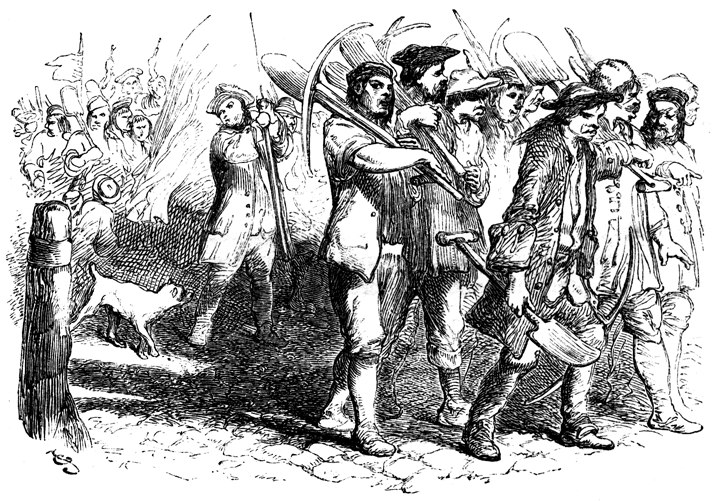
The value of shares in the Louisiana, or Mississippi stock, had fallen very rapidly, and few indeed were found to believe the tales that had once been told of the immense wealth of that region. A last effort was therefore tried to restore the public confidence in the Mississippi project. For this purpose, a general conscription of all the poor wretches in Paris was made by order of government. Upwards of six thousand of the very refuse of the population were impressed, as if in time of war, and were provided with clothes and tools to be embarked for New Orleans, to work in the gold mines alleged to abound there. They were paraded day after day through the streets with their pikes and shovels, and then sent off in small detachments to the out-ports to be shipped for America. Two-thirds of them never reached their destination, but dispersed themselves over the country, sold their tools for what they could get, and returned to their old course of life. In less than three weeks afterwards, one-half of them were to be found again in Paris. The manœuvre, however, caused a trifling advance in Mississippi stock. Many persons of superabundant gullibility believed that operations had begun in earnest in the new Golconda, and that gold and silver ingots would again be found in France.
In a constitutional monarchy some surer means would have been found for the restoration of public credit. In England, at a subsequent period, when a similar delusion had brought on similar distress, how different were the measures taken to repair the evil; but in France, unfortunately, the remedy was left to the authors of the mischief. The arbitrary will of the regent, which endeavoured to extricate the country, only plunged it deeper into the mire. All payments were ordered to be made in paper, and between the 1st of February and the end of May, notes were fabricated to the amount of upwards of 1500 millions of livres, or 60,000,000l. sterling. But the alarm once sounded, no art could make the people feel the slightest confidence in paper which was not exchangeable into metal. M. Lambert, the president of the parliament of Paris, told the regent to his face that he would rather have a hundred thousand livres in gold or silver than five millions in the notes of his bank. When such was the general feeling, the superabundant issues of paper but increased the evil, by rendering still more enormous the disparity between the amount of specie and notes in circulation. Coin, which it was the object of the regent to depreciate, rose in value on every fresh attempt to diminish it. In February, it was judged advisable that the Royal Bank should be incorporated with the Company of the Indies. An edict to that effect was published and registered by the parliament. The state remained the guarantee for the notes of the bank, and no more were to be issued without an order in council. All the profits of the bank, since the time it had been taken out of Law’s hands and made a national institution, were given over by the regent to the Company of the Indies. This measure had the effect of raising for a short time the value of the Louisiana and other shares of the company, but it failed in placing public credit on any permanent basis.
A council of state was held in the beginning of May, at which Law, D’Argenson (his colleague in the administration of the finances), and all the ministers were present. It was then computed that the total amount of notes in circulation was 2600 millions of livres, while the coin in the country was not quite equal to half that amount. It was evident to the majority of the council that some plan must be adopted to equalise the currency. Some proposed that the notes should be reduced to the value of the specie, while others proposed that the nominal value of the specie should be raised till it was on an equality with the paper. Law is said to have opposed both these projects, but failing in suggesting any other, it was agreed that the notes should be depreciated one half. On the 21st of May, an edict was accordingly issued, by which it was decreed that the shares of the Company of the Indies, and the notes of the bank, should gradually diminish in value, till at the end of a year they should only pass current for one-half of their nominal worth. The parliament refused to register the edict—the greatest outcry was excited, and the state of the country became so alarming, that, as the only means of preserving tranquillity, the council of the regency was obliged to stultify its own proceedings, by publishing within seven days another edict, restoring the notes to their original value.
On the same day (the 27th of May) the bank stopped payment in specie. Law and D’Argenson were both dismissed from the ministry. The weak, vacillating, and cowardly regent threw the blame of all the mischief upon Law, who, upon presenting himself at the Palais Royal, was refused admittance. At nightfall, however, he was sent for, and admitted into the palace by a secret door,12 when the regent endeavoured to console him, and made all manner of excuses for the severity with which in public he had been compelled to treat him. So capricious was his conduct, that, two days afterwards, he took him publicly to the opera, where he sat in the royal box alongside of the regent, who treated him with marked consideration in face of all the people. But such was the hatred against Law that the experiment had well nigh proved fatal to him. The mob assailed his carriage with stones just as he was entering his own door; and if the coachman had not made a sudden jerk into the court-yard, and the domestics closed the gate immediately, he would, in all probability, have been dragged out and torn to pieces. On the following day, his wife and daughter were also assailed by the mob as they were returning in their carriage from the races. When the regent was informed of these occurrences he sent Law a strong detachment of Swiss guards, who were stationed night and day in the court of his residence. The public indignation at last increased so much, that Law, finding his own house, even with this guard, insecure, took refuge in the Palais Royal, in the apartments of the regent.
The Chancellor, D’Aguesseau, who had been dismissed in 1718 for his opposition to the projects of Law, was now recalled to aid in the restoration of credit. The regent acknowledged too late, that he had treated with unjustifiable harshness and mistrust one of the ablest, and perhaps the sole honest public man of that corrupt period. He had retired ever since his disgrace to his country house at Fresnes, where, in the midst of severe but delightful philosophic studies, he had forgotten the intrigues of an unworthy court. Law himself, and the Chevalier de Conflans, a gentleman of the regent’s household, were despatched in a post-chaise with orders to bring the ex-chancellor to Paris along with them. D’Aguesseau consented to render what assistance he could, contrary to the advice of his friends, who did not approve that he should accept any recal to office of which Law was the bearer. On his arrival in Paris, five counsellors of the parliament were admitted to confer with the Commissary of Finance; and on the 1st of June an order was published abolishing the law which made it criminal to amass coin to the amount of more than five hundred livres. Every one was permitted to have as much specie as he pleased. In order that the bank-notes might be withdrawn, twenty-five millions of new notes were created, on the security of the revenues of the city of Paris, at two-and-a-half per cent. The bank-notes withdrawn were publicly burned in front of the Hôtel de Ville. The new notes were principally of the value of ten livres each; and on the 10th of June the bank was re-opened, with a sufficiency of silver coin to give in change for them.
D’AGUESSEAU.
These measures were productive of considerable advantage. All the population of Paris hastened to the bank to get coin for their small notes; and silver becoming scarce, they were paid in copper. Very few complained that this was too heavy, although poor fellows might be continually seen toiling and sweating along the streets, laden with more than they could comfortably carry, in the shape of change for fifty livres. The crowds around the bank were so great, that hardly a day passed that some one was not pressed to death. On the 9th of July, the multitude was so dense and clamorous that the guards stationed at the entrance of the Mazarin Gardens closed the gate and refused to admit any more. The crowd became incensed, and flung stones through the railings upon the soldiers. The latter, incensed in their turn, threatened to fire upon the people. At that instant one of them was hit by a stone, and, taking up his piece, he fired into the crowd. One man fell dead immediately, and another was severely wounded. It was every instant expected that a general attack would have been commenced upon the bank; but the gates of the Mazarin Gardens being opened to the crowd, who saw a whole troop of soldiers, with their bayonets fixed ready to receive them, they contented themselves by giving vent to their indignation in groans and hisses.
Eight days afterwards the concourse of people was so tremendous that fifteen persons were squeezed to death at the doors of the bank. The people were so indignant that they took three of the bodies on stretchers before them, and proceeded, to the number of seven or eight thousand, to the gardens of the Palais Royal, that they might shew the regent the misfortunes that he and Law had brought upon the country. Law’s coachman, who was sitting at the box of his master’s carriage, in the court-yard of the palace, happened to have more zeal than discretion, and, not liking that the mob should abuse his master, he said, loud enough to be overheard by several persons, that they were all blackguards, and deserved to be hanged. The mob immediately set upon him, and thinking that Law was in the carriage, broke it to pieces. The imprudent coachman narrowly escaped with his life. No further mischief was done; a body of troops making their appearance, the crowd quietly dispersed, after an assurance had been given by the regent that the three bodies they had brought to shew him should be decently buried at his own expense. The parliament was sitting at the time of this uproar, and the president took upon himself to go out and see what was the matter. On his return he informed the councillors that Law’s carriage had been broken by the mob. All the members rose simultaneously, and expressed their joy by a loud shout, while one man, more zealous in his hatred than the rest, exclaimed, “And Law himself, is he torn to pieces?”13